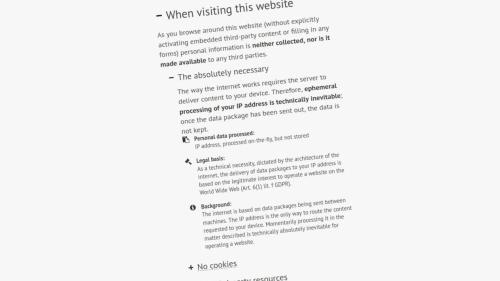
Among a long list of formal requirements, the GDPR demands privacy policies to be easy to access and understand. This privacy policy is a showcase of how legal requirements can be met while also being useful to the user.
Related
Terms of Service; Didn't Read

“I have read and agree to the Terms” is the biggest lie on the web. We aim to fix that.
Terms of Service; Didn't Read (ToS;DR) is a site that dissects the terms and privacy policies nobody ever reads and evaluates services based on these.
While the site states that the ratings are out of date, a recent blog post gives hope for a new breath of life to this project.
We have seen improvements in the past years on the wording of Terms of Services but no improvements of the practices and today, the situation is still worrying.
Chatting on Whatsapp, dating on Tinder, sending photos on Snapchat, saving work on Dropbox... those are parts of our everyday lives. Can we leave those services? What is done with our data? Who can access it? Those are questions that are still difficult to answer.
Open source privacy notice design patterns (juro-privacy/free-privacy-notice)

If you're working with privacy notices for the web, chances are that you have seen the privacy policy of juro.com, which rose to fame during the 2018 spring of GDPR panic as an example of legal design applied in a real-world project.
Juro and Stefania Passera, the designer behind the project, have now open-sourced the underlying patterns and code for everybody to build upon (I refrain from writing "to use", as this is not a copy-paste template but building bricks to work with).
A lawyer rewrote Instagram's terms of service for kids

There is a lot of interesting analysis and recommendation in the "Growing up digital" report from the UK's Children's Commissioner referenced in this article - and the simplified terms and conditions (that nobody ever reads) are only the most obvious of its gems - , but the truly interesting aspect is that it is not only children that lack the digital literacy required to understand what using "free services" on the web implies:
according to the report, only people with postgraduate levels of education could properly understand Instagram’s terms and conditions.
Similarly, the Commission's policy recommendations could easily be extended to literacy work for the general (adult) public.
In particular, the second recommendation (write terms and conditions that children understand) would be of great benefit: just as accessibility features in a website improve usability for everybody regardless of their abilities, making terms and conditions simple to understand would improve their understandability for everybody regardless of age.
Seriously: how many of grown up Instagram users are aware of the few examples bolded by the Quartz editors here? These are (a small excerpt from) the rules under which millions of people upload their private pictures to the internet every day.
via The Engine Room