A comprehensive discussion on the design considerations of this project has been published in the inaugural issue of the Legal Design Journal in summer 2024:
Recht ohne Streit
Legal design research project to promote autonomous dispute resolution (ADR) – creating an interactive, lay-friendly guide to solving legal conflicts using alternative methods
“Recht ohne Streit” aims to democratise access to justice by empowering citizens as active agents in their legal conflicts
Alternative dispute resolution (ADR) offers a plethora of methods for resolving conflicts more efficiently and satisfactorily than litigation. However, most non-lawyers are unaware of the existence of arbitration, conciliation, mediation, etc., as legally valid alternatives to a court ruling. Confrontation is on a layperson’s mind, yet fear of escalation and costs – sometimes even distrust of the system – may lead to inaction: “Justice” remains behind an imaginary paywall, seemingly inaccessible to many.
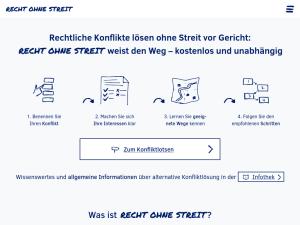
To bring “getting their right” into everyone’s reach, Recht ohne Streit (rechtohnestreit.de; roughly translatable to “justice without contention”) aims to provide guidance to those affected by legal disputes, prominently featuring alternatives to going to court. Finding the most suitable pathway, however, requires more than simply entering conflict details into an algorithm to receive a solution: ADR demands readiness to negotiate and compromise; intrinsic goals for resolving a conflict stand at the core of choosing the most appropriate route.
Therefore, such a web-based application has to be more than merely a navigator. It must educate and motivate individuals to accept ownership of their conflict at hand and to act towards a desirable outcome. This is not an easy endeavour, given the limited attention span of internet users and the pervasive promise of technology to remove friction. Consequently, what may at first appear like a technology project, is really about shaping an interface to “justice” – with the potential to change the perception of what it entails and, as we were to experience, raise societal questions much more profound than merely the creation of a digital tool.
Taking people by the hand
A thorough benchmarking of existing conflict navigator tools revealed an inspiring range of solutions, generally tailored to limited areas of conflict. These often provide streamlined funnels to specific solutions, as they are provided with the explicit aim of directing users to services offered or promoted by their providers. Some are, by design or inadvertently, geared more towards legal professionals. Regardless of these limitations, each and every one of them has been an important stepping stone for further developing the idea of web-based conflict advice: good design iterates, rather than reinventing the wheel.
Current solutions, often framed as exploratory MVPs (minimum viable products) or prototypes, are dominated by linear decision trees, and equally linear user flows: “if this, then that”, with some variation based on certain variables. While their legal basis is prominent (more than once highlighted by requests to accept “disclaimers” before even displaying their start screen), their user interface design and technical implementation often show less attention to best practice: many are unusable on mobile devices, the use of UI affordances such as checkboxes and radio buttons may be in conflict with established usability principles, or the user experience may be that of filling in tax forms rather than a pleasant flow. Web accessibility guidelines frequently appear to be ignored altogether, contradicting the promise of “access to justice for all”.
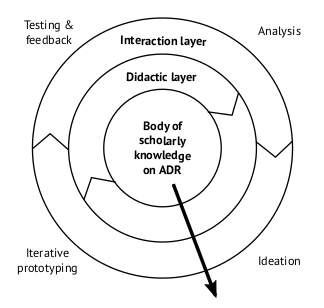
We started by codifying a solid core of scientific knowledge about ADR and its applicability in different areas of conflict – an ontology of sorts – and identifying the thought processes and variables required to make an informed decision. This didactic flow was then wrapped in an interaction layer presented in the browser, with the aim of providing pleasant and motivating user paths. Both the didactic and interaction layers went through a continuous loop of ideation, prototyping, testing and analysis until we reached a first MVP, which was used for a six-month public evaluation period.
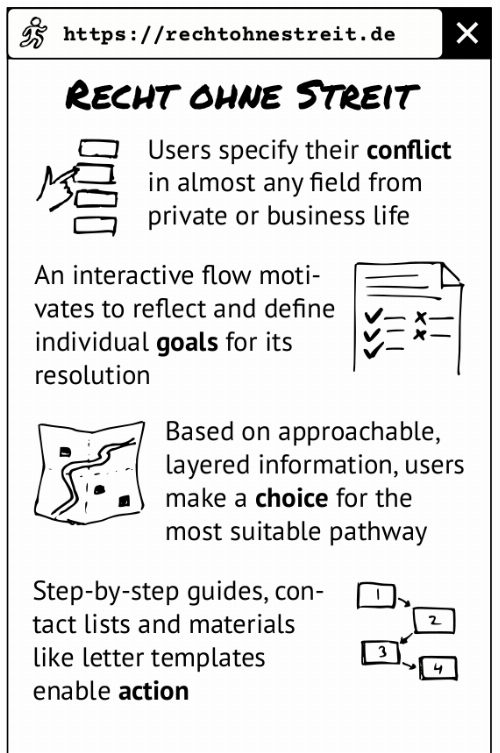
In the initial stages of the project, we focused on developing an overall interaction logic and the required content structures. Derived from how guidance would be provided in an offline setup, we defined four main steps: describing the conflict, clarifying interests, assessing appropriate pathways, and following step-by-step guidance for a chosen approach.
Four steps, each with its own challenges
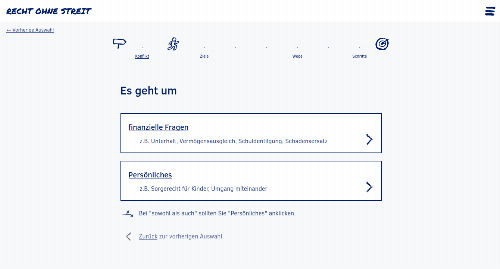
Given that Recht ohne Streit intends to provide guidance for the broadest possible range of conflicts, the prototype’s entry point is a rather conventional hierarchical categorization, aided by keyword search. User testing confirmed its general suitability, but also highlighted challenges, particularly for multi-dimensional conflicts. For a future iteration, we hope to experiment with NLP (natural language processing), where the system would suggest conflict categories based on a free-form text entry. While the UI is generally designed to resemble a conversation more than filling out a form (users do not select answers and submit with a button, but one click leads onwards immediately), an even more conversational interface could increase the appeal. We deliberately stayed away from chatbot metaphors, as these are often so obtuse as to alienate rather than engage users.
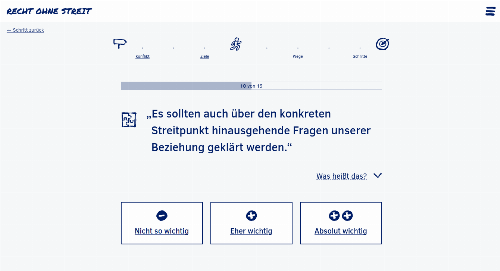
After indicating the nature of their conflict, users are invited to follow a guided exploration of their interests. Is it important to emphasise that the other side was wrong? Or is it important to resolve the conflict quickly, even at the cost of making concessions? This part went through several iterations and is still a work-in-progress. Not unexpectedly, a fair number of users dropped out before even starting the self-assessment of their interests (there is still a lot of design work to be done on expectation management, but also on developing a prominent “fast track” bypass to faster, more general recommendations). Those who chose to engage, on the other hand, mostly showed little difficulty in clicking through a streamlined interface assigning “irrelevant”, “somewhat important” or “very important” to up to 20 variables. However, displaying the summary of choices, along with the request to limit the top interests to a maximum of six, once again demonstrated the inherent conflict between usability and verbosity. In a future iteration, we hope to make this flow more playful to reduce the mental effort. Gamification, while not uncontroversial in the context of legal applications, holds great promise for better UX in such use cases.
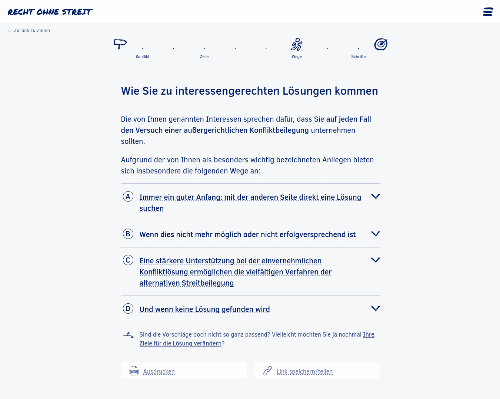
The third step is an overview of ADR approaches that are considered appropriate given the nature of the conflict and the interests involved. This required the most iteration and revision. Even before usability considerations, an early stage prototype invalidated initial thoughts about presenting recommendations in a ranked listing. While we soon settled on the advice (unless precluded by the user’s stated goals) to always negotiate directly first or find a neutral moderator (“home remedies” as a gateway to alternative conflict resolution), more formalised methods were impossible to rank. In the end, we settled on the well-established “layered presentation” pattern, which our tests confirmed reduced overwhelm and facilitated comprehension. We gathered a number of ideas for further iteration of this part of the application, particularly through visual design elements (which the MVP unfortunately fell short of, due to limited resources).
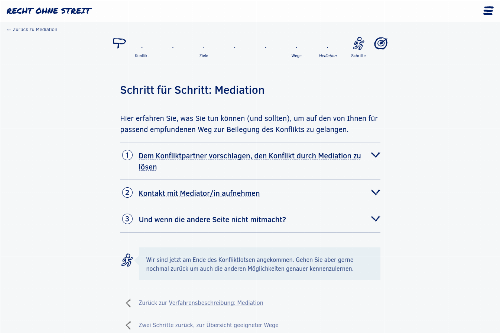
Once users have familiarised themselves with the options available – including detailed presentations explaining procedures, costs, and even case stories – the web application provides contacts, resources, letter templates and more for the chosen course of action. It also addresses one of the biggest barriers to ADR: motivating the other party. Input from our testing phase indicates a strong desire for even more practical guidance, where our academic objective to remain independent may limit the user experience. Having partnered with a legal protection insurer to recruit test users, we experimented with tailored guidance for them. Ideally, future implementations could aim for close integration with actual service providers, public or private, like some of the benchmarked services. However, this requires significant commitment and leads to the question of who would be a suitable host for a future ADR platform such as Recht ohne Streit.
An overarching architectural limitation of our approach emerged early on: this four-step, standardised flow is too rigid, given the range of conflict types covered. By using the same formula for all conflicts, the user experience often feels constrained. For example, when dealing with conflicts in the financial or travel sectors, industry arbitration boards or ombudsman procedures result in a very different type of guidance than when dealing with conflicts where up to half a dozen of ADR methods may need to be assessed. Our plans for the next iteration hence include a more dynamic user guidance.
Eight proto-principles for “interactive legal design”
Designated as a foundational research project, we aimed to explore the use of interactive design in the context of “legal” – how does a system have to be designed to provide a broader audience with access to law? Eight preliminary design principles emerged from our work:
- Give people agency over their legal interests: Our tool is not an opaque algorithm that asks a few questions, then tells what to do. We empower lay people (and experts alike) to understand how legal conflicts can be resolved and that they need to prioritise their goals. This requires a certain level of engagement, but ultimately improves access to justice better than magic turnkey solutions.
- Take the “legalese” out of the “legal”: As much of the authoring is inevitably done by legal experts, we aim to always review our content through the eyes of a lay person. We explain legal jargon, avoid references and concepts that non-lawyers would not understand, and generally try to get rid of legal language wherever it is not absolutely necessary.
- Don't oversimplify; stay transparent: We aim for “quality simple”: while we strive to make the tool and its use straightforward, we do not hide the complexity of the subject. Whenever our system applies filters or makes recommendations, we inform the user and provide means to understand the reasoning and to modify these variables.
- Be playful while remaining trustworthy: Legal tools don't have to be dead serious. We try to inject some lightness, even gamification elements, while ensuring that they remain trustworthy and reliable. Decades of UI and usability research remind us that legal design does not have to look like an Excel spreadsheet or a court letter.
- Put user value before “lawyer habits”: Anti-patterns, such as asking users to accept a disclaimer before they even start, are lawyer-centric, not user-centric design. We don't scare users away with restrictions before presenting results. Better still, we let the content itself convey its limitations. We want to make “legal” approachable, not intimidating.
- Collect as little data as possible: No one dealing with a legal issue wants to be profiled by unknown third parties. We ensure that our front-end never connects to other servers and that no user is tracked in an identifiable way. For our research, we collect minimal usage data in such a non-intrusive way that we don't even need the dreaded “cookie banner” – that's great UX, too!
- Keep it accessible and “mobile first”: Removing technical barriers is essential to lowering the threshold for the access to justice. Accessibility is part of the process early on (the “V” in MVP stands for “viable”; excluding users based on ability or equipment is the opposite of viable). We apply the “mobile first” dogma from web design to legal design; always designing with outdated, low-cost smartphones in sub-optimal conditions in mind.
- Simplify the tech stack: Over-engineering is futile. By keeping it simple, we ensure good performance, accessibility and universal usability. “Progressive enhancement” ensures that our application will even work on an old device with an outdated browser, aggressive privacy settings, and slow internet. Radical simplicity also makes maintenance a lot easier.
While succeeding in applying some of these better than others, the emergence of this set of guidelines is in itself an important outcome of our research. This project specifically aimed to identify solution spaces – and room for development and debate – where legal design and interaction design in combination can make law more accessible. The use of interactive media for legal guidance has a lot of potential, but it is also very easy for oversights in design and execution to become a hindrance to aspirational goals.
The intricate conflict between simplicity and complexity
Design is often misunderstood as a magic wand that turns “complex” into “simple”. As our work on the ADR conflict assistant highlights, complexity cannot always be hidden, when it is critical to the process. Most of the challenges in our work therefore stem from this very issue. Choosing a suitable pathway to resolving a conflict requires people to reflect on their goals and understand the varying outcome. This can only be simplified to a limited extent – a conundrum between conflict theory, which demands increased mental effort, and usability principles, which aim to minimise it.
By presenting a different kind of conflict guidance, we hope to facilitate a discourse on how digital tools may assist without oversimplifying, while at the same time creating engaging user experiences. In addition, we deliberately chose to deviate from the dominant “form-like” UIs to a more conversational paradigm, to experiment with layered presentation, to engage more clicks rather than fewer, to eliminate obtrusive disclaimers and cookie pop-ups, and to apply an accessible “mobile first” front-end design.
As is the role of a successful prototype, our MVP provides inspiration for improvement more than it delivers teachable “best practices”. However, in addition to generating and validating ideas, prototypes play yet another important role: by turning an abstract hypothesis into a tangible object, the idea of a universal, self-determined conflict navigation aid becomes something that can be experienced. This has sparked a welcome debate: countless interactions with legal practitioners, representatives of judiciary and legislature, legal protection insurers, and others, as well as numerous publications in newsletters, blogs, and journals, have stimulated an inspiring debate on the role of ADR and its promotion as part of the ongoing efforts to “digitise justice”.
Ultimately, “justice for all” is about lowering the threshold of access – deepening the combination of legal design with domain expertise in interactive design promises opportunities to open new doors as of yet undiscovered. We look forward to seeing how our ideas live on in future iterations of our tools and those of others.
Greger, S. (2024). “Recht ohne Streit” aims to democratise access to justice by empowering citizens as active agents in their legal conflicts. Legal Design Journal, "Studio". Issue 1.
Project fact sheet
What if … an interactive helper could remove barriers for everybody to "get their right" in a legal conflict?
- Type
- Concept exploration by prototype
- Url
- https://rechtohnestreit.de
- Year
- 2024
- Status
- completed